Political Alignments on Iranian Instagram
In September 2026, Factnameh conducted an extensive open-source network analysis of Persian-language political accounts on Instagram, uncovering a large shift in the platform’s political landscape. Over the past twelve months, Instagram has evolved from a largely passive broadcasting platform into a highly dynamic and increasingly polarized political arena, where digital influence, political legitimacy, and competing ideological narratives are actively contested. This transformation was triggered by severe geopolitical shocks, including the June 2025 12-Day War, the nationwide protests and state crackdown in January 2026, the unprecedented 88-day nationwide internet shutdown, and the subsequent 40-Day War from February to April 2026. What was historically an ecosystem dominated by offline presence, artistic recognition, and celebrity status has increasingly become a political space in its own right, shaped by daily content production, sharper ideological divisions, and growing network polarization.
Key Takeaways
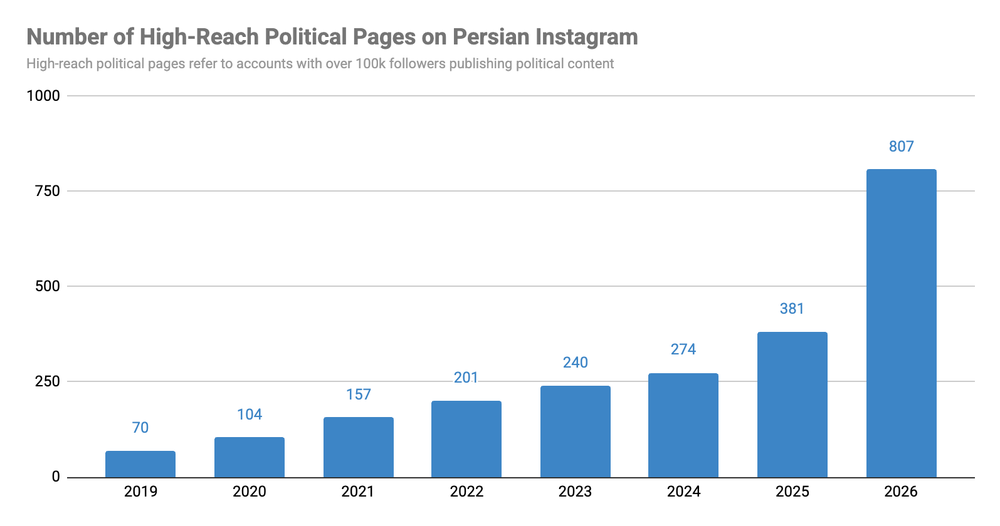
- Rapid Network Expansion: The number of high-reach political Instagram accounts (>100,000 followers) doubled in 2026. The active dataset grew from 381 accounts in 2025 to 807 saturated accounts by September 2026, more than doubling the high-reach political sphere within a single year.
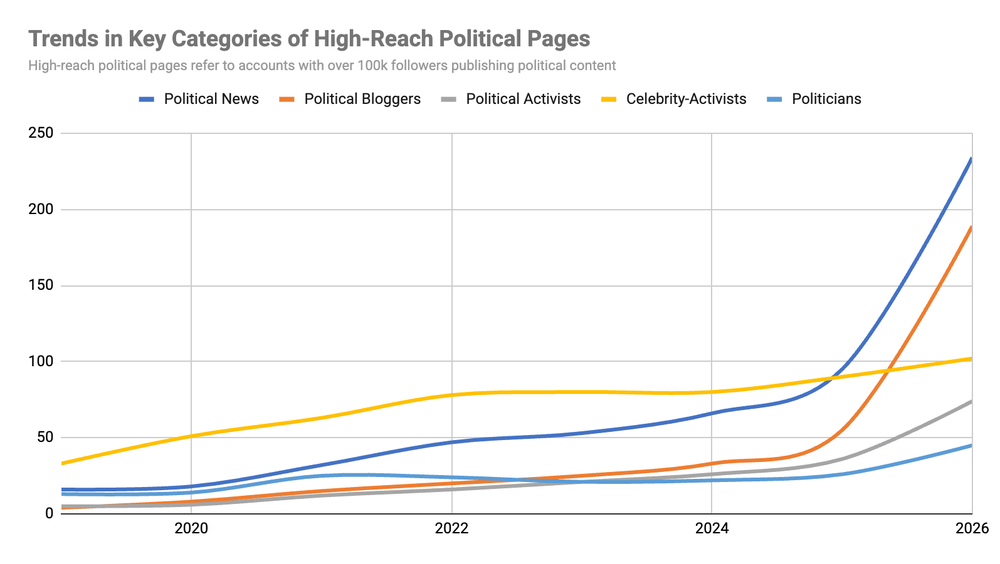
- Declining Influence of Celebrity-Activists: Celebrity-activists, who served as a primary political reference group on Iranian Instagram until 2023, had fallen to third place in overall network influence by September 2026. Severe legal prosecutions, commercial bans, asset pressures, and threats to their career forced many public figures to abandon political commentary and instead publish non-political content.
- The Shift from Offline Fame to Online Influence: Offline fame is no longer the main source of digital authority. Continuous content production and interactive online engagement are helping establish new bloggers as political authorities, who now account for 23% of the network (189 accounts), making them the second-largest category after Political News outlets (29%, or 234 accounts).
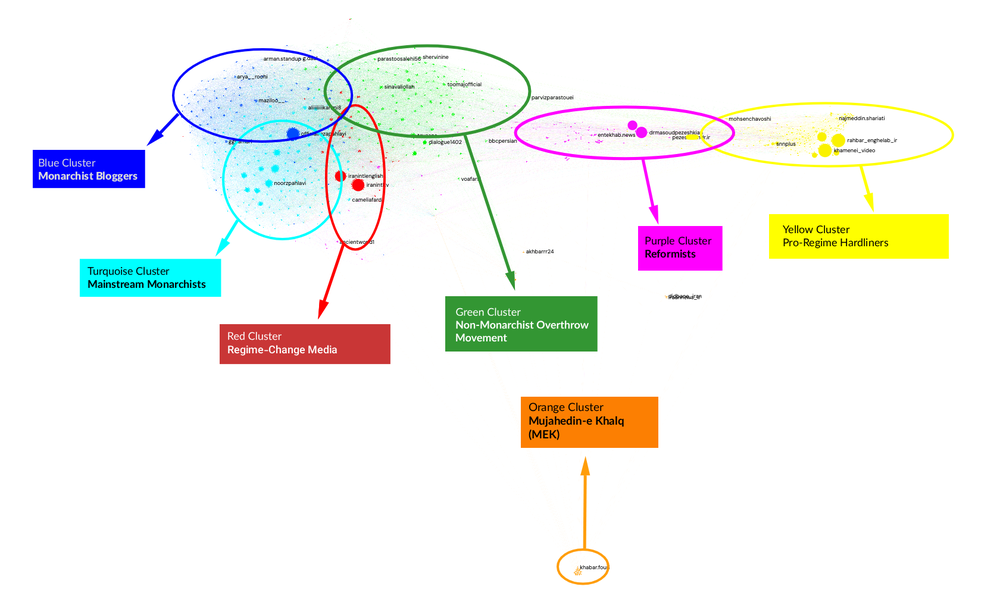
- Seven Distinct Political Clusters: Community detection using the Louvain algorithm identified seven distinct political groups, distributed along an ideological spectrum from pro-regime positions to advocates of regime change.
- Echo Chambers and Uneven Gender Representation: Accounts in some political clusters tend to follow others within their own group, rather than accounts belonging to different political groups. This is particularly true within pro-regime (89%) and MEK-aligned (67%) (supporters of the People’s Mojahedin Organization of Iran, an Iranian opposition group) online communities, demonstrating extreme isolation amongst the networks at the political fringes. The gender breakdown of personal accounts also varies sharply across groups: men account for 95.6% of personal accounts in the Pro-Regime cluster and 95.8% in the Reformist cluster, while the Non-Monarchist Opposition cluster shows an even gender split (50% female and 50% male).
These changes reflect the combined effects of major political events, state censorship, and shifting audience behavior, which have fundamentally reshaped political activism on Iranian social media.
The digital communications landscape in Iran in the lead-up to September 2026 was shaped by unprecedented state censorship, domestic unrest, and major regional conflicts. During 2025 and 2026, the country experienced a series of major events: the 12-Day War in June 2025; mass anti-government protests in January 2026, followed by a severe state crackdown on January 8–9; an unprecedented 88-day nationwide internet shutdown; and the 40-Day War between February and April 2026, during which Supreme Leader Ali Khamenei was killed and succeeded by his son, Mojtaba Khamenei. Throughout these crises, while other global platforms remained heavily blocked or throttled, Instagram functioned as the primary digital space where Iranian citizens, political figures, and media outlets shared information, reported real-time developments, expressed public sentiment, and debated political legitimacy.
Mapping high-reach political accounts (>100,000 followers) offers insight into how political discourse and polarization take shape in Iran. As the state increased the legal and economic risks of political expression through business closures, judicial summonses, and tighter regulatory controls, established channels of political communication came under growing pressure. Studying how accounts gain and maintain influence on Instagram helps show how civil society groups, political movements, and state-aligned actors adapt to internet restrictions and establish new paradigms of digital influence.
Studying how accounts gain and maintain influence on Instagram helps show how civil society groups, political movements, and state-aligned actors adapt to internet restrictions.
Dataset and Link-Tracing Methodology
Data collection and network analysis were conducted in September 2026 . The study used publicly available Instagram data to map the network of high-reach Persian-language political accounts and examine how they are connected. It focused on accounts with large audiences that play an active role in shaping political discourse.
Methodological Framework
- Account Selection Criteria: The study included active Instagram accounts with more than 100,000 followers that primarily addressed Iranian audiences. To qualify, an account's content over the preceding twelve months had to focus mainly on Iranian political news, policy analysis, ideological commentary, political debate, calls to action, or civic activism.
- Snowball Mechanics: To reduce the selection bias inherent in platform search algorithms, the study used a snowball link-tracing sampling approach. First, an initial list of accounts was assembled to represent a range of political positions, from state-backed media outlets to networks advocating regime change. The researchers then examined the accounts followed by each account on the list, identifying additional high-reach political accounts. This process was repeated in successive rounds until no further accounts meeting the follower threshold were identified across the political groups under study.
- Final Sample Size: The sampling process was considered complete when additional rounds of tracing yielded no new accounts meeting the threshold of more than 100,000 followers. The final dataset contained 807 unique high-reach political accounts and approximately 31,000 directed following relationships between them.
This dataset provided the basis for analyzing the growth of political Instagram accounts, changes in account categories, and the position and influence of individual accounts within the network.
Growth in the Number of High-Reach Accounts and Category Definitions
Between 2019 and 2024, the number of high-reach political Instagram accounts grew gradually, from 70 to 274. Following the 12-Day War, the January 2026 protests, and the 40-Day War, the network expanded much more rapidly. The dataset grew to 381 accounts in 2025 and reached 807 by September 2026. This represents more than a doubling of the number of high-reach political accounts in just one year.
Account Categories and Their Distribution
The 807 high-reach accounts were divided into five main categories and one additional category:Political News (29% / 234 accounts): Accounts that primarily collect, report, and share political news and commentary. Prominent examples include individual journalists such as Morad Vaisi and media outlets such as Iran International and Manoto.
- Political Bloggers (23% / 189 accounts): Content creators who build their influence through regular political commentary, direct-to-camera analysis, and interaction with their audiences without prior offline political prominence. Examples include Maziyar Nazari, Fariborz Karami Zand, and Arya Rouhi.
- Celebrity-Activists (13% / 102 accounts): Public figures who originally gained large public followings through offline professional careers in cinema, sports, music, or the arts before engaging in political commentary. Examples include actor Hamid Farrokhnezhad, musician Shahin Najafi, and former athlete Sosha Makani.
- Political Activists (9% / 74 accounts): Individuals whose authority derives directly from offline political organizing, human rights campaigns, civic advocacy, or dissident actions. Prominent examples include Amir Hossein Etemadi, Ahmad Batebi, and Saeed Ghasseminejad.
- Politicians (5% / 45 accounts): Institutional political figures, party leaders, and political representatives, including Reza Pahlavi, Farah Pahlavi, Yasmine Pahlavi, and Masoud Pezeshkian.
- Other / Generic (21% / 169 accounts): Accounts that do not fit neatly into the other categories, including supplementary channels, lifestyle profiles that also publish political commentary, satire pages, and religious group feeds.
Network Centrality: HITS Dual-Score Mechanics vs. PageRank Centrality
Evaluating influence in a network of directed connections requires differentiating between accounts that are widely recognized by other influential accounts and those that occupy central positions in the network as a whole. To examine these different dimensions of influence, the study compares two measures of network centrality: Jon Kleinberg’s Hyperlink-Induced Topic Search (HITS) model and Google’s PageRank centrality algorithm. The results reveal different patterns of influence across the Iranian political Instagram network.
How the Two Algorithms Measure Influence
- HITS - Hubs and Authorities: Kleinberg’s HITS algorithm assigns two scores to each account: a Hub score and an Authority score. The Hub score measures how strongly an account connects to other accounts recognized as authorities. The Authority score measures how often an account is followed by accounts with high Hub scores. In the Persian-language political network, accounts with high Hub scores tend to link to and amplify prominent opposition and regime-change figures. As a result, the HITS Authority rankings are led by well-known opposition figures, activist journalists, and other public figures critical of the Iranian government. The five highest-ranked accounts by HITS Authority score are Hamid Farrokhnezhad, Shahin Najafi, Reza Pahlavi, Morad Vaisi, and Amir Hossein Etemadi.
- PageRank - Overall Network Centrality: PageRank measures an account's importance by considering both the number of accounts that follow it and the network position of those accounts. In other words, a follow from an account that is itself well-connected contributes more to an account's PageRank score than a follow from a less-connected account. In this study, official and affiliated accounts associated with the current and former Supreme Leaders (including @khamenei_ir) rank first and second across the network. Although these accounts have fewer followers than some leading opposition figures, they occupy central positions within a densely interconnected, highly centralized pro-government network. Reza Pahlavi ranks third overall by PageRank.
The two rankings reveal different patterns of influence: opposition figures rank highly in HITS Authority because of their connections to influential accounts, while state-aligned accounts lead PageRank due to their central position within a tightly connected pro-government network. The two measures capture different forms of network influence rather than a single measure of political authority.
The Shift in Political Reference Groups
Between 2019 and 2023, Celebrity-Activists were the leading political reference group on Iranian Instagram. Their numbers peaked in 2023, with 80 high-reach accounts, compared with just 25 Political Bloggers at the time. However, their influence declined sharply over the following three years, and by September 2026 they ranked third among the political actor categories.
Explaining the Shift
- Growing Legal, Economic, and Professional Pressure: Following successive waves of unrest, particularly the January 2026 protests, state pressure on politically active public figures intensified. Celebrities faced commercial restrictions, judicial summonses, asset seizures, and professional blacklisting. These pressures increased the personal, legal, and financial risks of political commentary. Many public figures subsequently stepped back from political activism and returned to primarily professional or non-political content.
- The Rise of Political Bloggers: As celebrities became less politically active online, bloggers who had built their audience on Instagram gained prominence. Digital authority on Instagram now requires daily video production, direct-to-camera analysis, and constant engagement with audience commentary. Political Bloggers grew from 25 high-reach accounts in 2023 to 189 in 2026, becoming the second-largest category in the network and an increasingly prominent source of political commentary.
Network Topography and Louvain 7-Cluster Analysis
To identify political sub-groups within the 807-account network, the study applied the Louvain Community Detection algorithm. The method identifies clusters by examining patterns of connections between accounts and grouping together those that are more closely connected than to the rest of the network. The analysis identified seven distinct political clusters based on Instagram following relationships.
The resulting network map reveals clear divisions between political groups. The clusters are arranged along an apparent ideological spectrum, with pro-government accounts concentrated toward one end and groups advocating regime change toward the other. The position of each cluster reflects its connections to other accounts in the network, as well as the political orientation identified through the analysis of its members.
Click on the link to see the interactive version of the graph and access the data.
Cluster Yellow — Pro-Regime Hardliners
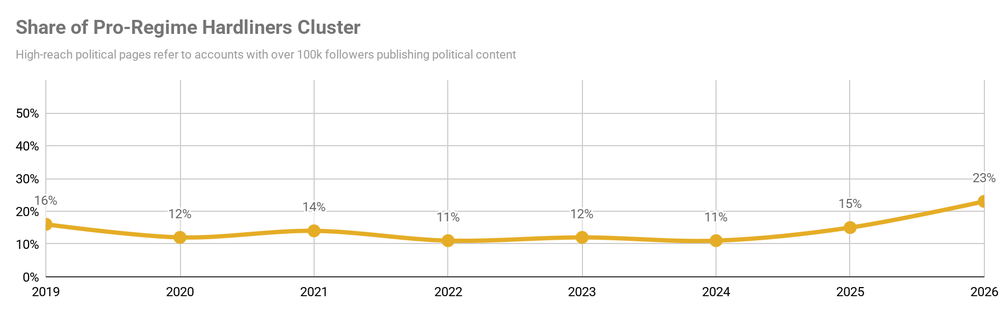
Representing 23.4% of the overall network (189 accounts), the Yellow cluster is the single largest ideological grouping on Persian-language Instagram.
- Ideological Breakdown: 94% Principalist (“Osoolgera” in Persian), 5% Reformist, 1% Unspecified/Neutral.
- Key Accounts: Official accounts dedicated to current, former, and historical Supreme Leaders (including @khamenei_ir), religious eulogists (maddahs), conservative clerics, religious groups (heyats), and selected state-aligned public figures including Mohsen Chavoshi and Majid Vasheghani.
- Account Classification and Gender Ratios: The cluster consists of 60% personal profiles and 40% institutional or non-personal aggregators. Among personal accounts, men account for 96%, compared with 4% for women, indicating a pronounced gender imbalance.
- Longitudinal Trajectory: Despite prominent figures in this cluster advocating for internet restrictions, platform bans, and migration to state-backed domestic platforms, the cluster reached its largest share of the overall network in 2026. The Yellow cluster's share of the network fluctuated between 11% and 16% from 2019 to 2024, before rising to 15% in 2025 and 23.4% in 2026.
Cluster Purple — Reformists and Domestic Media
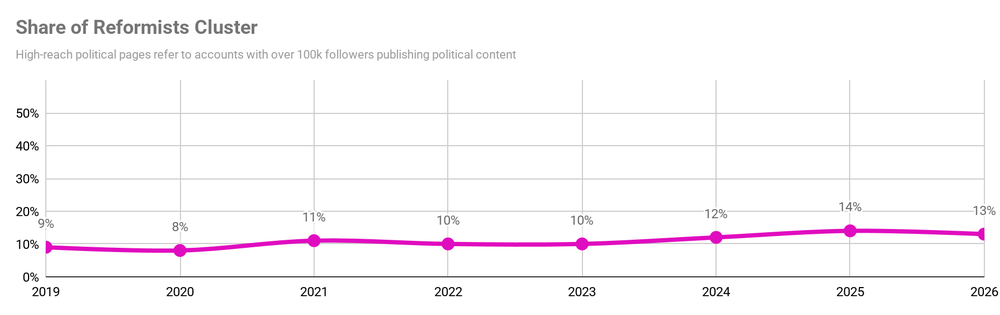
Accounting for 13.3% of the network (107 accounts), the Purple cluster brings together domestic reformist political factions, state-sanctioned economic press, and moderate domestic media.
- Ideological Breakdown: 45% Reformist, 18% Transformationalist (Tahavol-khwah), 18% Regime-Change (Barandaz), 7% Principalist (Osoolgera), 13% Unspecified/Neutral.
- Key Accounts: Prominent domestic media organizations including EcoIran, Donya-e-Eqtesad, Resanah Azad, and Shargh Daily, alongside political figures such as Masoud Pezeshkian.
- Account Classification and Gender Ratios: Accounts split 45% Personal / 55% Non-Personal. Among personal accounts, men account for 95.8%, compared with 4.2% for women, indicating a pronounced gender imbalance.
- Longitudinal Trajectory: The Purple cluster maintained a relatively stable share of the network, fluctuating between 8% and 14% from 2019 to 2026.
Cluster Green — Non-Monarchist Opposition and Foreign Media
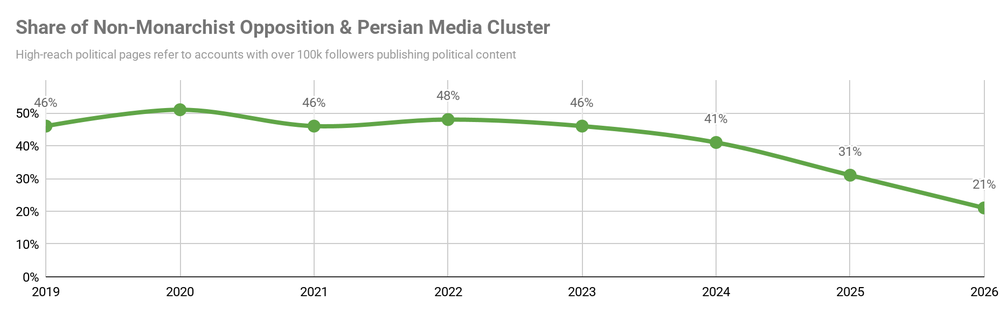
Comprising 20.9% of the overall network (169 accounts), the Green cluster represents a heterogeneous coalition of non-monarchist opposition factions, foreign Persian-language news outlets, and civic activists.
- Ideological Breakdown: 66% Regime-Change (Barandaz), 24% Transformationalist (Tahavol-khwah), 7% Reformist, 1% Principalist, 3% Unspecified/Neutral.
- Key Accounts: Major foreign-based Persian news outlets including BBC Persian, Radio Farda, and Voice of America (VOA) Persian.
- Account Classification and Gender Ratios: The cluster consists of 75% personal accounts and 25% non-personal accounts. Among personal accounts, women and men are equally represented, each accounting for 50%. This makes the Green cluster the most gender-balanced group in the network.
- Longitudinal Trajectory: The Green cluster has the highest concentration of Celebrity-Activists, who account for 30% of its accounts. Its share of the network declined from a peak of 51% in 2020 to 20.9% in 2026.
Cluster Red — Regime-change Media ("Barandaz")
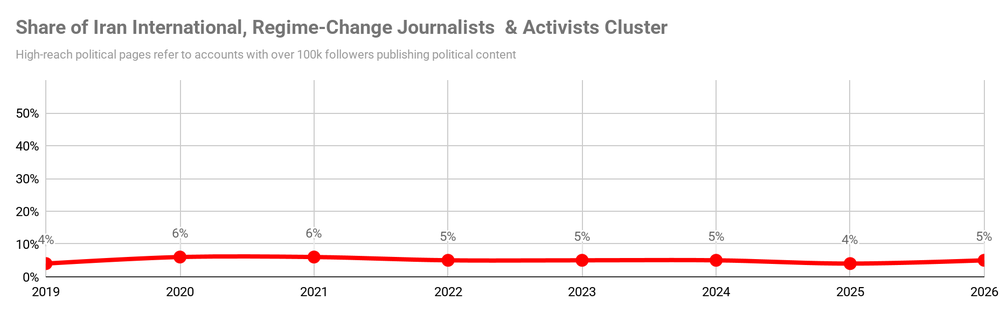
Representing 4.6% (~5%) of the network (37 accounts), the Red cluster is centered on radical regime change and broadcast journalism.
- Ideological Breakdown: 92% Regime-Change (Barandaz), 8% Unspecified/Neutral.
- Key Accounts: Persian and English accounts of Iran International, alongside its prominent broadcast journalists, staff analysts, and commentators.
- Account Classification and Gender Ratios: The cluster consists of 70% personal accounts and 30% non-personal accounts. Among personal accounts, 73.1% are male and 26.9% are female.
- Longitudinal Trajectory: The Red cluster has maintained a relatively stable share of the network, fluctuating between 4% and 6% from 2019 to 2026.
Cluster Turquoise — Mainstream Monarchists
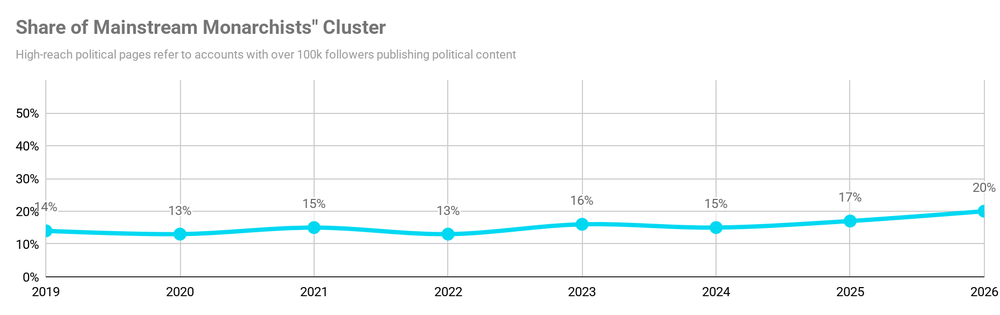
Accounting for 19.7% (~20%) of the network (159 accounts), the Turquoise cluster represents the core mainstream monarchist movement supporting Reza Pahlavi.
- Ideological Breakdown: 99% Regime-Change (Barandaz), 1% Unspecified/Neutral.
- Key Accounts: Accounts organically affiliated with Reza Pahlavi, Manoto broadcast network, and victim families from protest crackdowns.
- Emergence of Victim Families: Families of individuals killed during state repression (e.g., during the January 2026 crackdown) have become prominent voices on Iranian Instagram. Translating grief and moral legitimacy into digital influence, these accounts have formed a vital sub-category of political leadership within the mainstream monarchist sphere.
- Account Classification and Gender Ratios: The cluster consists of 71% personal accounts and 29% non-personal accounts. Among personal accounts, 64% are male and 36% are female.The cluster consists of 71% personal accounts and 29% non-personal accounts. Among personal accounts, 64% are male and 36% are female.
- Longitudinal Trajectory: The Turquoise cluster reached its largest share of the network in 2026, growing from 14% in 2019 to 19.7%.
Cluster Blue — Monarchist Bloggers
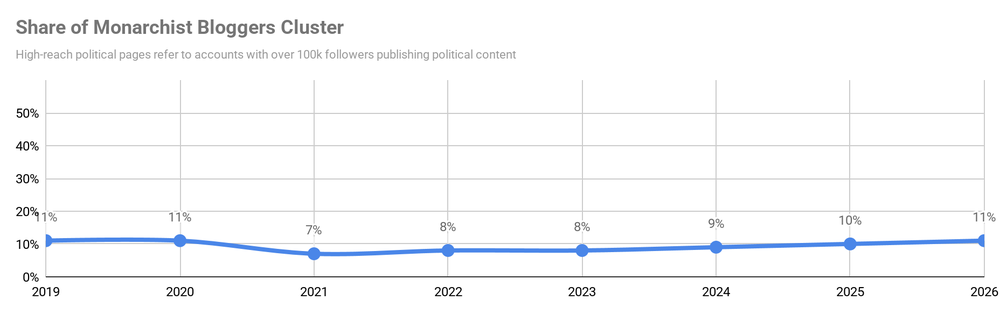
Comprising 11.0% of the overall network (89 accounts), the Blue cluster represents a platform-native monarchist blogging ecosystem.
- Ideological Breakdown: 100% Regime-Change (Barandaz).
- Key Accounts: Primarily individual content creators who produce political commentary and advocate for monarchist restoration.
- Account Classification and Gender Ratios: Highly personal network (91% Personal / 9% Non-Personal), with personal accounts recording 72.5% Male / 27.5% Female.
- Structural Role: Political Bloggers account for 54% of the cluster, the highest concentration of this category across the seven clusters. This highlights the prominent role of individual content creators in the monarchist network.
- Longitudinal Trajectory: The Blue cluster's share of the network remained relatively stable, ranging from 7% to 11% between 2019 and 2026.
Cluster Orange — MEK-Aligned "Breaking News"
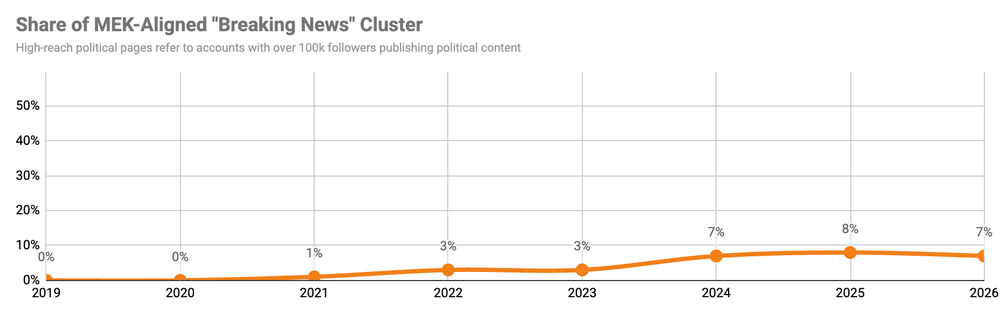
Representing 7.1% of the network (57 accounts), the Orange cluster consists of accounts affiliated with or aligned with the People's Mojahedin Organization of Iran (the Mujahedin-e Khalq or MEK).
- Ideological Breakdown: 53% Regime-Change (Barandaz), 44% Unspecified/Neutral, 4% Reformist.
- Key Accounts: Operates primarily through non-personal aggregate accounts branded under generic "Breaking News" (Khabar-e-Fori) titles to disguise political affiliation while broadcasting targeted political messaging.
- Account Classification and Gender Ratios: The cluster is predominantly non-personal, with 82% non-personal accounts and 18% personal accounts. Among personal accounts, 80% are male and 20% are female.
- Longitudinal Trajectory: The Orange cluster emerged in 2021 and grew to account for 7.1% of the network by 2026.
Demographic Breakdown and Actor Composition
Table 1: Cluster Demographics and Account Type Breakdown
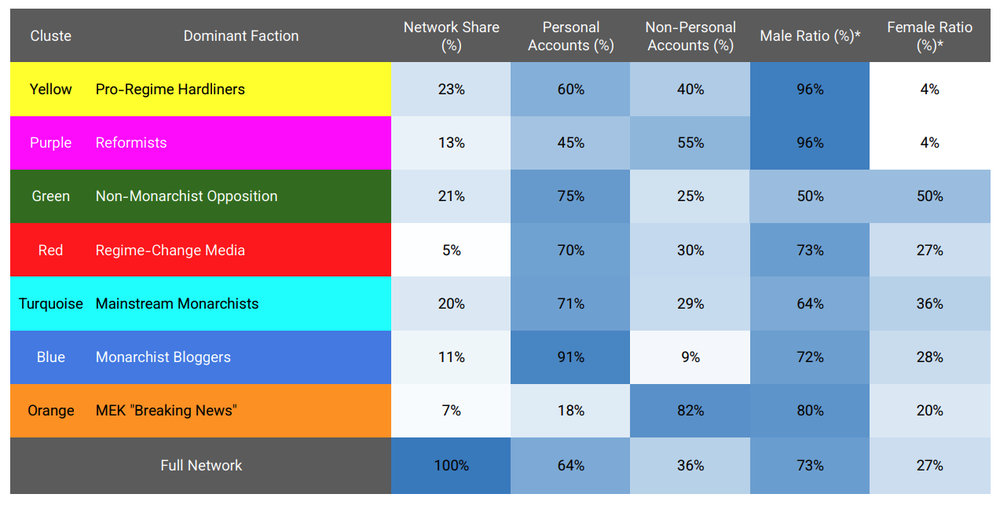
*Note: Gender ratios calculated exclusively across personal accounts within each cluster based on underlying dataset specifications.
Table 2: Actor Composition Across Clusters (% of Cluster Total)
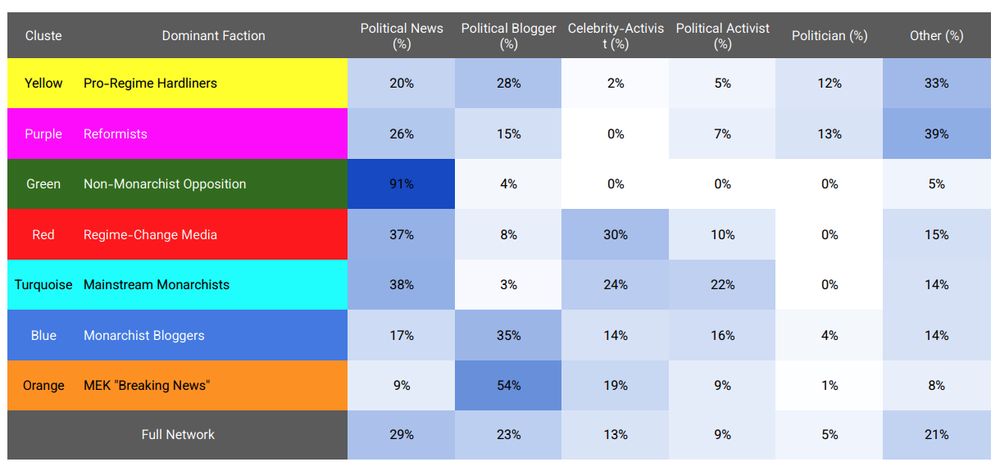
Table 3: Inter-Cluster Follower Dynamics Matrix (Who Follows Whom)
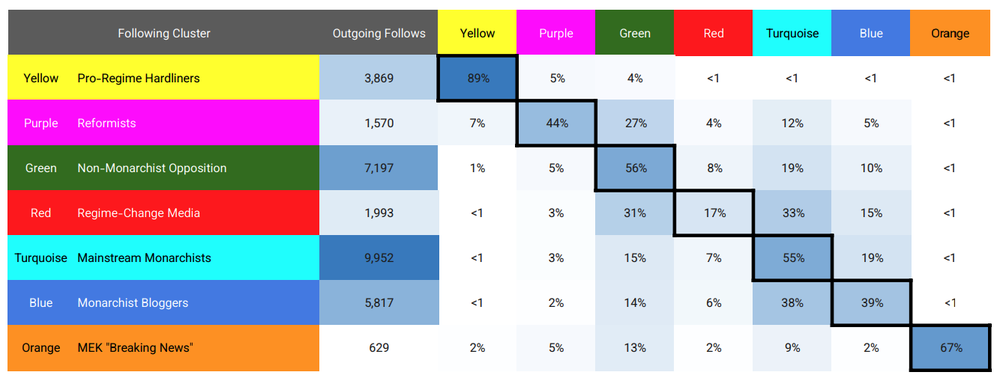
Inter-Cluster Following Patterns
Analysis of the following relationships between clusters reveals strong patterns of internal affiliation, close connections between some political groups, and varying levels of interaction across ideological boundaries.
- Extreme Isolation at Network Fringes: The Pro-Regime Hardliner cluster (Yellow) directs 89% of its 3,869 outgoing follows toward accounts within the same cluster, with less than 1% going to opposition clusters. Similarly, the MEK-aligned Orange cluster directs 67% of its 629 outgoing follows internally, operating as an isolated digital island.
- Monarchist Symbiosis: Mainstream Monarchists (Turquoise) and Monarchist Bloggers (Blue) are closely connected to one another. Mainstream Monarchist accounts direct 55% of their follows internally and 19% towards Monarchist Blogger accounts (74% combined allegiance). Reciprocally, Monarchist Bloggers direct 39% internally and 38% to Mainstream Monarchists (77% combined allegiance).
- Reformist and Opposition Bridges: The Reformist cluster (Purple) has a more outward-facing following pattern. While 44% of its follows remain within the cluster, 27% go to Green Non-Monarchists, 12% to Turquoise Mainstram Monarchists, and 7% to Yellow Hardliners. This distribution suggests that the Reformist Purple cluster has connections across several different political groups and functions as a structural bridge between domestic policy spaces and external media environments.
Conclusion
This investigation shows that Persian-language political Instagram has changed significantly, with political influence increasingly shifting from established public figures to content creators who build their audiences through regular online activity. Internet shutdowns, state pressure, and changing audience behavior have all contributed to a more polarized political landscape, organized around distinct ideological and network communities.
Key Insights
- The Shift from Celebrity Influence to Online Content Creators: Political influence on Iranian Instagram increasingly depends on regular content production and direct daily audience engagement rather than offline fame or public status. Political Bloggers have become a major source of political commentary, gaining prominence as the influence of traditional celebrity-activists has declined..
- Intensified Echo Chambers: Some political clusters show an extremely high concentration of internal reciprocity at ideological extremes, particulary among Pro-Regime Hardliners (89%) and MEK-aligned networks (67%), reinforcings isolated echo chambers and thus limiting cross-ideological dialogue and deepening societal polarization.
- Gender Differences Across Ideological Lines: A pronounced demographic divide exists across Iranian political Instagram. Domestic pro-regime and reformist personal accounts remain almost exclusively male-dominated (>95% male), whereas opposition spaces, particularly the Non-Monarchist Green cluster (50% female parity), exhibit equal female leadership and representation.
Methodological Note and Scope Limitations
This network investigation captured the dynamics of high-reach political communication on Instagram. Its findings and conclusions are subject to the following methodological limitations:
- Account Scope: The dataset consists exclusively of active, public Instagram accounts with over 100,000 followers broadcasting Iranian political content as of September 2026 .
- Excluded Media Spaces: The study does not encompass private user profiles, micro-influencers (<100,000 followers), non-political commercial storefronts, or conversations occurring on alternative platforms (e.g., Telegram, X, YouTube).
- Algorithmic Fluidity: Louvain cluster assignments reflect inter-account follow relationships recorded at the moment of data extraction in September 2026. Because these network follow structures change over time, cluster membership may also shift as the network evolves and new data are collected.